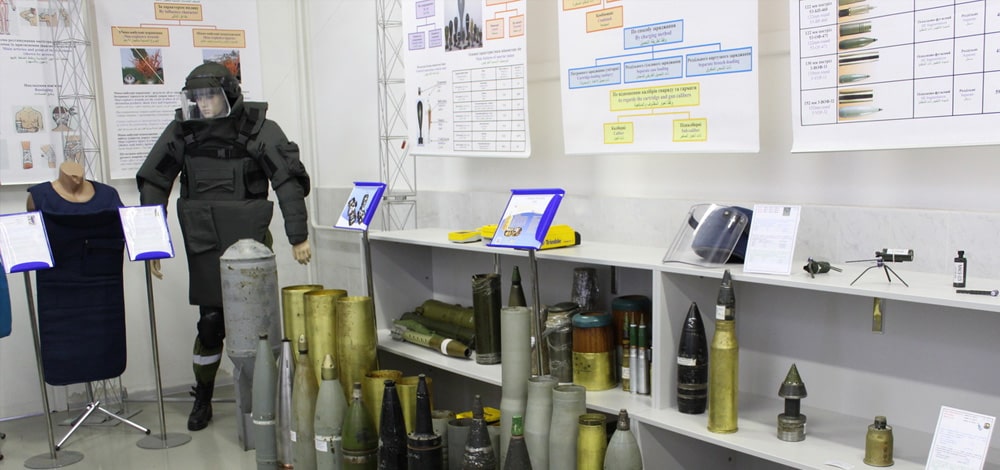
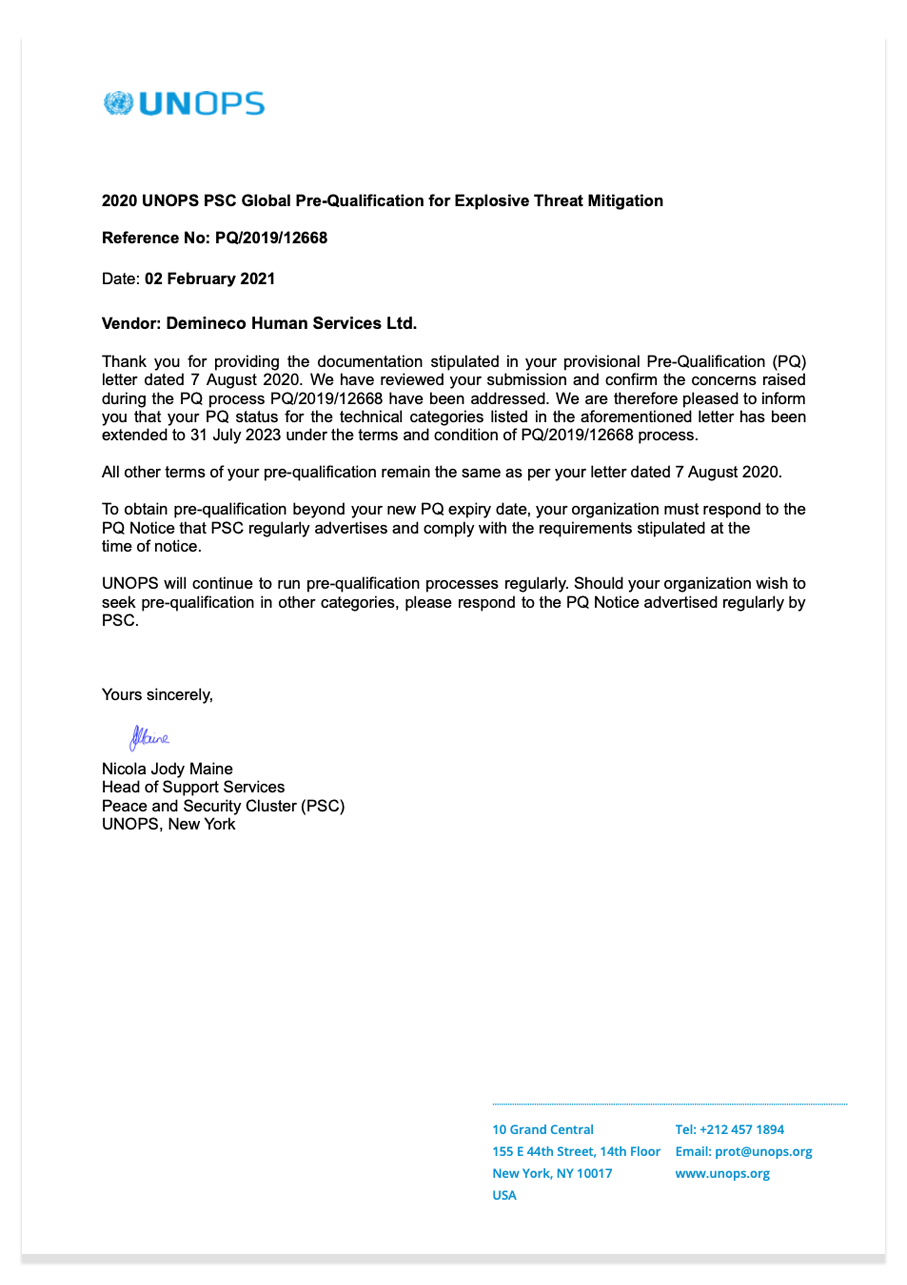
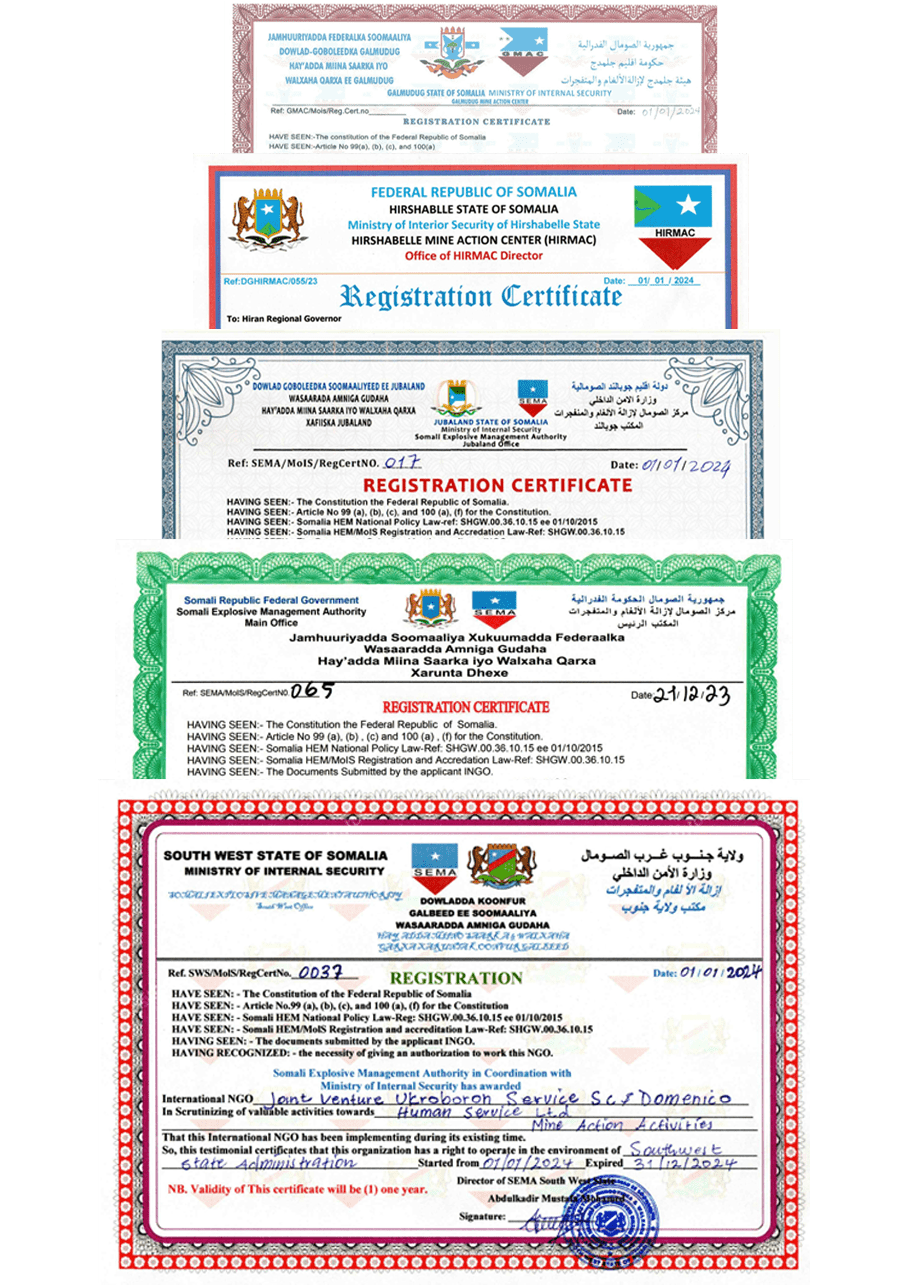
To enhance the effectiveness and safety of demining
and disposal operations, DHS also offers a
comprehensive range of specialized equipment,
including:
-
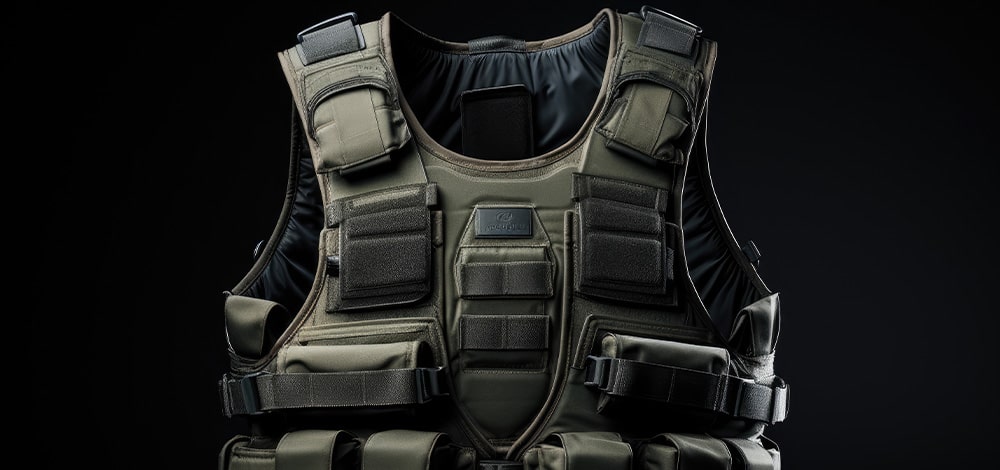
Personal protective equipment (PPE) and demining
suits
- Detection and clearance tools
- EOD and demolition kits
-
Secure transport and storage systems for
explosives
By integrating expert services with reliable,
mission-ready equipment, DHS ensures that every
operation is executed with precision, safety, and
sustainable impact.
DHS is an independent consulting group
with the in-house capacity to design, implement, and
oversee
objective, data-driven, and cost-effective
solutions
specifically tailored for the humanitarian demining
sector. Our independence allows us to remain
impartial and results-oriented, ensuring that every
recommendation is guided by operational realities,
international standards, and the best interests of
affected communities.
We leverage a multidisciplinary
approach—combining technical expertise, field
experience, and strategic planning—to develop
customized methodologies that reduce risk, optimize
resources, and enhance overall mission
effectiveness. Whether supporting donor-funded
programs, government agencies, or non-governmental
organizations, DHS delivers scalable and sustainable
solutions that meet both humanitarian and
operational goals.
Our work is fully compliant with the
International Mine Action Standards
(IMAS).
These internationally recognized
guidelines—developed under the auspices of the
United Nations—provide a framework for safe,
effective, and accountable mine action activities
around the world.
At DHS, adherence to IMAS is not just a procedural
requirement—it is a core principle embedded in
every aspect of our operations. From planning and
risk assessment to field implementation, quality
assurance, and post-clearance reporting, we ensure
that all activities are conducted in strict
alignment with IMAS protocols.
This commitment guarantees:
-
Operational safety for both
personnel and affected communities
-
Technical integrity in land
release, clearance, and EOD activities
-
Transparency and accountability
for donors, partners, and stakeholders
-
Environmental responsibility and
ethical conduct
-
Consistency with global best practices
and UN-endorsed methodologies
By following IMAS, DHS not only meets the highest
international standards but also reinforces trust,
professionalism, and long-term impact in every
mission we undertake.
At DHS, we offer a
comprehensive suite of services in
the fields of
humanitarian demining, explosive ordnance
disposal (EOD), demilitarisation, weapons
destruction, and explosives and ammunition
management (EAM). Our integrated approach ensures that every aspect
of explosive hazard mitigation is covered—from
initial threat assessment to final clearance and
disposal.
Our capabilities include:
-
Humanitarian Demining: Survey,
detection, clearance, and land release operations,
conducted in line with International Mine Action
Standards (IMAS) to restore safe access to
contaminated areas.
-
Explosive Ordnance Disposal (EOD): Identification, rendering safe, and disposal of
unexploded ordnance (UXO) and other hazardous
devices, tailored to both humanitarian and
post-conflict settings.
-
Demilitarisation & Weapons
Destruction: Secure dismantling and destruction of small
arms, light weapons, and surplus
ammunition—supporting disarmament,
demobilisation, and reintegration (DDR) processes.
-
Explosives and Ammunition Management
(EAM): Safe storage, inventory control, risk
assessment, and lifecycle management of
conventional munitions, in alignment with
international safety guidelines and best
practices.
Provision of Experts, Equipment, and
Training
We support our clients with a
complete operational framework,
including:
-
Deployment of qualified specialists, including EOD technicians, demining teams,
logistics experts, and risk education advisors.
-
Supply of certified equipment
tailored to mission requirements—ranging
from personal protective gear and detection
devices to destruction and transport systems.
-
Customized training programs for
local and international personnel, covering
technical operations, safety protocols, quality
assurance, and capacity building.
By combining field-tested experience with scalable
support services, DHS enables governments, NGOs, and
international agencies to carry out complex
explosive hazard operations safely, efficiently, and
sustainably.
DHS undertakes Independent Quality Management
(QM) reviews
of third-party demilitarisation solutions and
operations, providing clients with unbiased, expert
evaluations that ensure their specific requirements,
safety standards, and operational objectives are
fully met.
Our Quality Management services are
designed to:
-
Verify compliance with
international standards, including the
International Ammunition Technical Guidelines
(IATG), IMAS, and client-specific protocols
-
Assess technical processes,
equipment usage, and personnel competency involved
in the demilitarisation and disposal of weapons
and ammunition
-
Identify risks, gaps, or inefficiencies
in third-party operations that may compromise
safety, accountability, or cost-effectiveness
-
Provide actionable recommendations
for improvement, helping stakeholders achieve full
transparency, regulatory alignment, and optimal
results
As an independent and experienced consultant, DHS
brings
objectivity, discretion, and technical
depth
to every review, ensuring that your investment in
third-party services delivers the intended
outcomes—safely, securely, and to the highest professional
standard.
At DHS, we employ proven management and
coordination techniques
specifically tailored to ensure the successful
execution of each project—on time, within
budget, and in full compliance with applicable
international and national frameworks.
Our approach is guided by:
-
Strategic Planning and Goal Alignment: We begin every project with a clear
understanding of the client’s objectives,
operational context, and regulatory environment.
This ensures that all activities—from
planning to execution—are purpose-driven and
outcome-oriented.
-
Integrated Project Management
Methodologies: DHS applies internationally recognized project
management practices, including risk management,
stakeholder engagement, milestone tracking, and
continuous performance monitoring.
-
Regulatory and Standards Compliance: All our operations strictly adhere to relevant
international standards such as
the
International Mine Action Standards
(IMAS)
and the
International Ammunition Technical Guidelines
(IATG), as well as
host nation legislation and national
protocols. We maintain full awareness of evolving
regulations to ensure up-to-date compliance in
every operational environment.
-
Efficient Resource Coordination:
We coordinate multidisciplinary teams, logistical
assets, and technical resources with
precision—maximizing efficiency while
minimizing disruptions or delays.
-
Transparent Communication and Reporting: Regular progress updates, compliance
documentation, and quality assurance reports are
integral to our process, fostering transparency
and trust with all stakeholders.
Through this structured and adaptive management
approach, DHS consistently delivers
safe, accountable, and mission-driven
solutions, even in the most complex or sensitive operational
settings.
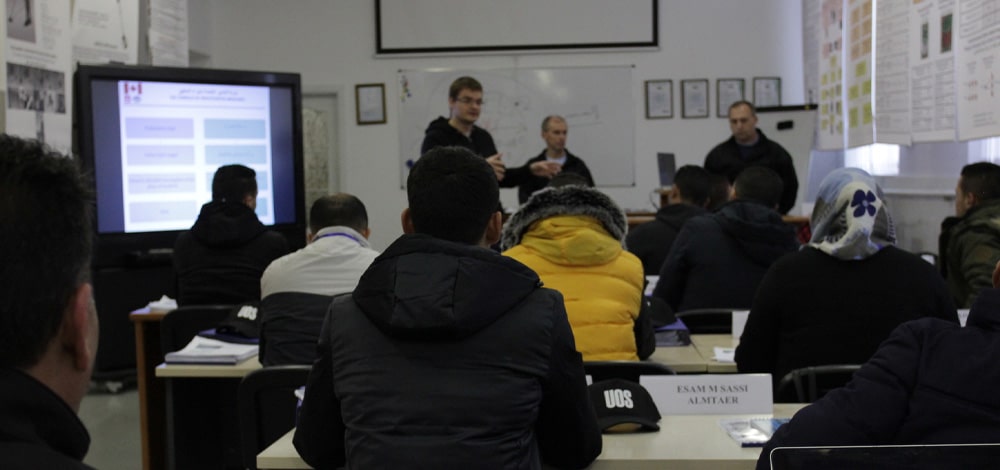
At DHS, we consider training to be an essential
pillar of successful operations, particularly in high-risk fields such as
humanitarian demining and explosive ordnance
disposal (EOD). We firmly believe that the
effectiveness, safety, and sustainability of any
mission depend on the skill, knowledge, and
preparedness of the personnel involved.
Training for Excellence, Safety, and
Sustainability
Our training programs are designed to develop and
maintain the
highest levels of competence in:
-
Project management and supervision
-
Field-level demining and EOD operations
-
Operational planning and risk
mitigation
-
Safety protocols and emergency response
-
Quality assurance and control
procedures
By providing structured, scenario-based, and
standards-compliant training, DHS ensures that
staff—whether international experts or local
partners—are fully capable of executing their
roles with confidence and precision.
Internationally Recognized Standards
All DHS training is aligned with
International Mine Action Standards
(IMAS),
International Ammunition Technical Guidelines
(IATG), and relevant
national regulations. We deliver
both initial certification and
continuing education to promote a
culture of professionalism, accountability, and
continuous improvement.
Customized & Context-Specific
Delivery
Whether training field operatives, supervisory
personnel, or national authorities, DHS develops
context-specific training modules
that reflect local challenges, available resources,
and mission-specific objectives. Training can be
delivered:
- On-site in operational environments
- At centralized training centers
-
Through mobile units or blended digital learning
formats
By investing in human capital, DHS helps ensure that
explosive hazard reduction efforts are not only
effective—but sustainable long after our work
is complete.
DHS actively assists in the development of
national and organizational strategies
in the fields of humanitarian demining, explosive
ordnance disposal (EOD), and ammunition safety
management. Our strategic support is designed to
help governments, NGOs, international organizations,
and other stakeholders shape effective, sustainable,
and well-coordinated responses to explosive threats.
Strategic Planning and Policy Development
We work closely with clients and national
authorities to:
-
Design evidence-based strategies
that align with international standards (such as
IMAS and IATG) and national priorities
-
Develop action plans, operational frameworks,
and risk reduction pathways
for mine action, EOD, and demilitarisation
programs
-
Support policy formation,
regulatory development, and institutional capacity
building
-
Integrate humanitarian, developmental, and
security perspectives
for comprehensive, long-term impact
Our approach combines technical expertise,
contextual understanding, and forward-looking
analysis to ensure that every strategy is
practical, achievable, and resilient.
Facilitating Dialogue and Information
Sharing
At DHS, we also place a strong emphasis on
promoting collaboration and the exchange of
information
among all stakeholders involved in mine action and
post-conflict recovery.
We:
-
Encourage inter-agency coordination
to eliminate duplication and streamline resources
-
Facilitate workshops, stakeholder meetings, and
technical roundtables
to foster dialogue and knowledge-sharing
-
Promote transparency and data-driven
decision-making
by helping stakeholders adopt effective reporting,
mapping, and information management systems (such
as IMSMA)
-
Build trust across sectors,
supporting civil-military cooperation,
humanitarian coordination, and community
engagement
By supporting both
strategic development and
collaborative frameworks, DHS helps
ensure that demining and EOD efforts are not only
operationally sound—but also deeply embedded
in broader national and international peacebuilding
and development goals.
Information Management for Smarter, Safer
Operations
The DHS Information Management System
(IMS)
is a core component of our operational framework,
purpose-built to enhance the
effectiveness, efficiency, and
accountability
of all demining, EOD, and explosive hazard
management activities.
Our IMS is designed to support
real-time data collection, analysis, and
reporting, enabling field teams, managers, and
decision-makers to work with clarity, precision, and
agility.
Key Features & Capabilities:
-
Operational Planning & Tasking: Streamlines the assignment and monitoring of
clearance tasks, team movements, and logistical
support to maximize field productivity.
-
Hazard Mapping & Risk Analysis: Integrates GIS-based tools to map contaminated
areas, analyze threat levels, and prioritize
interventions based on risk and impact.
-
Progress Tracking & Performance
Metrics: Monitors daily outputs, quality assurance
results, and mission milestones to ensure full
transparency and continuous improvement.
-
Incident Reporting & Safety
Monitoring: Allows for immediate reporting and response to
field incidents, near misses, or equipment
malfunctions—supporting a culture of safety
and accountability.
-
Customizable Dashboards & Reports: Offers stakeholders access to tailored reports
and real-time dashboards to support evidence-based
decision-making and donor reporting.
Integration & Compatibility
The DHS IMS is designed to be
compatible with industry-standard systems
such as
IMSMA (Information Management System for Mine
Action)
and is adaptable to client-specific platforms or
reporting formats. It can be deployed in
offline or low-connectivity environments, ensuring uninterrupted performance even in remote
or high-risk regions.